
Accountability
The work of the judiciary to promote accountability is based primarily on statutory tasks and the judiciary’s strategy.
The UN’s Agenda 2030 for sustainable development has formed the basis for the state administration’s sustainability thinking. Agenda 2030 is the UN’s action programme, which aims to eradicate extreme poverty and achieve sustainable development in terms of the environment, the economy and people’s well-being by 2030. The action programme has 17 sustainable development goals (Sustainable Development Goals, SDGs). In addition to these goals, the action programme has 169 sub-goals and 231 indicators, on the basis of which the achievement of the action programme is monitored globally. The responsibility for achieving the goals of Agenda 2030 lies with the governments of the countries, but achieving the goals requires the participation of all actors in society.
The UN Sustainable Development Goal 16. Peace, justice and strong institutions has been identified as the most relevant for the core task of the judiciary. In addition, the activities of the judiciary can also have a key impact on the achievement of Goals 5. Gender equality and 10. Reduced inequalities.

Sustainability in the Judiciary 2025
In Finland in 2025, more than 89% of citizens and 90% of companies believe that the independence of courts and judges is at a very good or rather good level. In 2024: citizens over 83% and companies 91%. (EU Justice Scoreboard)
World Justice Project – in the organization’s comparison, Finland is in the top 3 in the world as a rule of law state in 2025 (worldjusticeproject.org)
Open and transparent information
80% of new divorce applications are filed through the OmaTuomioistuin e-service, which was opened on 11.12.2025.


The tuomioistuimet.fi website had 1 209 584 visits in 2025.
Equality and non-discrimination
In 2025, 73% of the judiciary’s staff were women and 27% were men.
In 2025, the share of women among chief judges was 33%.

Economy
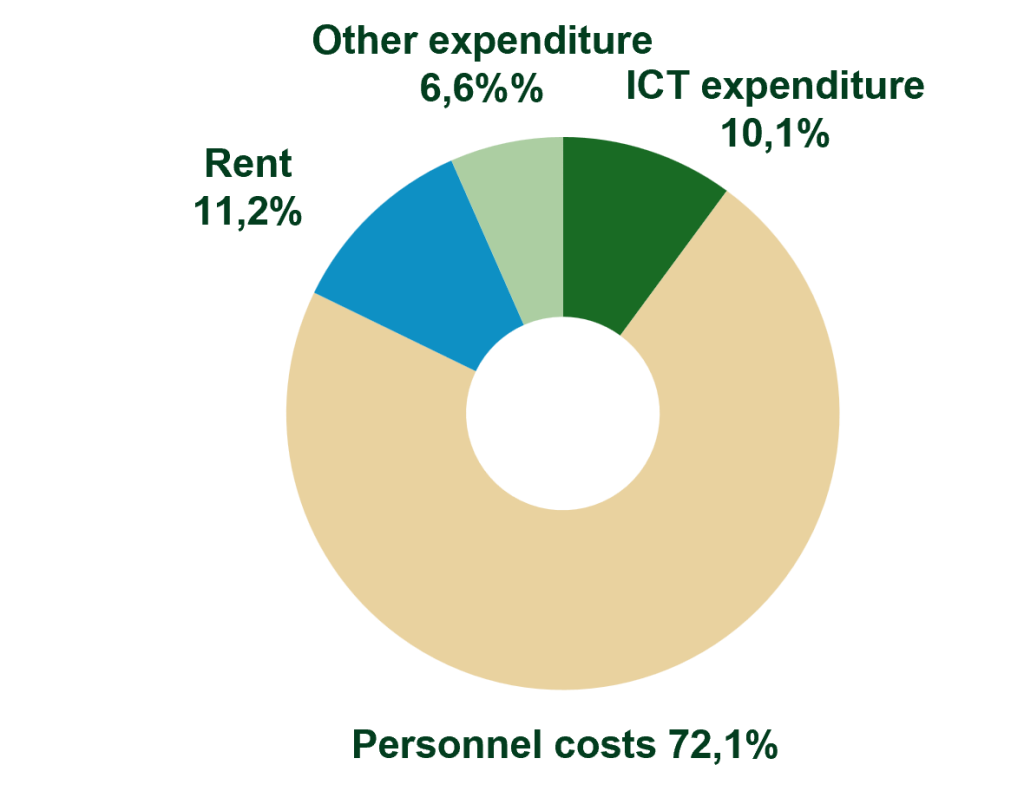
In 2025, the total use of operating expenditure for the judiciary was EUR 367.42 million. The expenditure was divided as follows:
- Personnel costs 72,1%
- Rent 11,2%
- ICT expenditure 10,1%
- Other expenditure 6,6%
Target for output: legal protection is equally available throughout the country
” The average duration of proceedings before a single court does not exceed the average for that line of courts by more than 3 months. ”
- In the courts of appeal, the deviation from the average processing time was 1.0 months in 2025 (2024: 1.7 months; 2023: 2.8 months).
- The longest average processing time per administrative court was 3.8 months (2024: 2.7 months; 2023: 3.2 months) different from the national average in 2025.
- In district courts, the longest district court-specific processing time (judgments on the merits) for criminal cases in 2025 differed by 4.1 months (2024: 3 months; 2023: 4.5 months) from the national average.
- In large civil cases (L cases), the longest processing time per district court deviated by 2.7 months (2024: 3.1; 2023: 4.1) from the national average in 2025.